Showing posts with label minimum wage. Show all posts

Wednesday, July 10, 2019

billion dollar Big Mac revisited

I once did a post about the minimum wage, McDonalds, and the Big Mac. I used the publicly available information at the time, and I did the math (FUN!). That was six years ago. Time flies and statistics change. How would that post read if written today?

Let's do it!

McDonalds 2013McDonalds 2018
Company Owned Locations6,7382,770
Franchise Locations28,69135,085

We can already see that McDonalds has shed many company owned locations in favor of franchise owned. This distributes the liability of employees to the franchisees. So there is one direct impact of the minimum wage that will affect local, small businesses to a greater degree than it will the large corporation. Raised wages will cripple the small business owner, and only trickle-up to the corporation.

Company-operated restaurant expenses ($millions)
Food & paper3,153.8
Payroll & employee benefits2,937.9
Occupancy & other operating expenses2,174.2
Franchised restaurants-occupancy expenses1,973.3
Selling, general & administrative expenses2,200.2

They directly employ 210,000 employees as of 2018. I don't have how many are employed by francisees. So we'll have to extrapolate franchise employees. If we do, we get about 2.5 million franchise employees. Previously, only about half of all employees were US-based. So, let's say only 1.25 million franchise employees are in the US, and we will ignore the McDonald's corporate employees, because we're not sure how many are salary versus hourly. And if we say 20% of the franchise employees are salary, that gives us a cool one million employees to work with.

1,000,000 McDonalds employees in the US
$7.50 minimum wage
$15.00 desired wage
550,000,000 Big Macs sold per year

Let's do math! (FUN!)
1,000,000 x ($15.00 - $7.50) = an additional $7,500,000 to employ all McDonalds employees for one hour.
but they don't all work at the same time... let's assume there are many more part-time workers than full time... and let's estimate each worker works and average of only 20 hours during any given week... we'll estimate low, just y'know, because we don't want to be unrealistic.
$7,500,000 x 20 = an additional $150,000,000 to pay for one week of all McDonalds employees.
there are 52 weeks in a year... usually.
$150,000,000 x 52 = an additional $7,800,000,000 to pay the additional wages of all McDonalds employees for one full year.
that's 7.8 Billion additional dollars... that has to come from somewhere... like raising the price of Big Macs.
$7,800,000,000 / 550,000,000 = an additional $14.18 per Big Mac.
what are they now, like $4.39?... so a Big Mac would cost $18.57 plus tax... no fries... no shake.
We just learned a few things. In the last six years since I first wrote the "Billion Dollar Big Mac", McDonalds has undergone some changes. First, they've shed corporate employees, but overall employment has risen. Second, the price of a Big Mac has nearly doubled. Lastly, the effect of the minimum wage has only worsened.

And who does it still effect? The poor and the small business owners.
the "rich" don't pay for Big Macs... it's the working poor... it's the same people who work at places like McDonalds who then shop and eat at places like McDonalds... it's us... we have to come up with $7.8 billion dollars.

sources:
https://rvolt24.blogspot.com/2013/08/billion-dollar-big-mac.html
https://corporate.mcdonalds.com/corpmcd/investors-relations/financial-information/sec-filings.html
http://d18rn0p25nwr6d.cloudfront.net/CIK-0000063908/94ad07bd-66c3-433c-a81e-94f1587b0ed8.pdf
https://www.reference.com/food/many-big-macs-sold-day-225cf538abc342ab

Friday, June 2, 2017

Six Reasons Libertarians Should Reject the Non-Aggression Principle - Re-Blog

Six Reasons Libertarians Should Reject the Non-Aggression Principle
A stringent application of the non-aggression principle has morally unacceptable implications.

Many libertarians believe that the whole of their political philosophy can be summed up in a single, simple principle. This principle—the “non-aggression principle” or “non-aggression axiom” (hereafter “NAP”)—holds that aggression against the person or property of others is always wrong, where aggression is defined narrowly in terms of the use or threat of physical violence.

From this principle, many libertarians believe, the rest of libertarianism can be deduced as a matter of mere logic. What is the proper libertarian stance on minimum wage laws? Aggression, and therefore wrong. What about anti-discrimination laws? Aggression, and therefore wrong. Public schools? Same answer. Public roads? Same answer. The libertarian armed with the NAP has little need for the close study of history, sociology, or empirical economics. With a little logic and a lot of faith in this basic axiom of morality, virtually any political problem can be neatly solved from the armchair.

On its face, the NAP’s prohibition of aggression falls nicely in line with common sense. After all, who doesn’t think it’s wrong to steal someone else’s property, to club some innocent person over the head, or to force others to labor for one’s own private benefit? And if it’s wrong for us to do these things as individuals, why would it be any less wrong for us to do it as a group – as a club, a gang, or…a state?

But the NAP’s plausibility is superficial. It is, of course, common sense to think that aggression is a bad thing. But it is far from common sense to think that its badness is absolute, such that the wrongness of aggression always trumps any other possible consideration of justice or political morality. There is a vast difference between a strong but defeasible presumption against the justice of aggression, and an absolute, universal prohibition. As Bryan Caplan has said, if you can’t think of counterexamples to the latter, you’re not trying hard enough. But I’m here to help.

In the remainder of this essay, I want to present six reasons why libertarians should reject the NAP. None of them are original to me. Each is logically independent of the others. Taken together, I think, they make a fairly overwhelming case.

  1. Prohibits All Pollution – As I noted in my last post, Rothbard himself recognized that industrial pollution violates the NAP and must therefore be prohibited. But Rothbard did not draw the full implications of his principle. Not just industrial pollution, but personal pollution produced by driving, burning wood in one’s fireplace, smoking, etc., runs afoul of NAP. The NAP implies that all of these activities must be prohibited, no matter how beneficial they may be in other respects, and no matter how essential they are to daily life in the modern industrialized world. And this is deeply implausible.
  2. Prohibits Small Harms for Large Benefits – The NAP prohibits all pollution because its prohibition on aggression is absolute. No amount of aggression, no matter how small, is morally permissible. And no amount of offsetting benefits can change this fact. But suppose, to borrow a thought from Hume, that I could prevent the destruction of the whole world by lightly scratching your finger? Or, to take a perhaps more plausible example, suppose that by imposing a very, very small tax on billionaires, I could provide life-saving vaccination for tens of thousands of desperately poor children? Even if we grant that taxation is aggression, and that aggression is generally wrong, is it really so obvious that the relatively minor aggression involved in these examples is wrong, given the tremendous benefit it produces?
  3. All-or-Nothing Attitude Toward Risk – The NAP clearly implies that it’s wrong for me to shoot you in the head. But, to borrow an example from David Friedman, what if I merely run the risk of shooting you by putting one bullet in a six-shot revolver, spinning the cylinder, aiming it at your head, and squeezing the trigger? What if it is not one bullet but five? Of course, almost everything we do imposes some risk of harm on innocent persons. We run this risk when we drive on the highway (what if we suffer a heart attack, or become distracted), or when we fly airplanes over populated areas. Most of us think that some of these risks are justifiable, while others are not, and that the difference between them has something to do with the size and likelihood of the risked harm, the importance of the risky activity, and the availability and cost of less risky activities. But considerations like this carry zero weight in the NAP’s absolute prohibition on aggression. That principle seems compatible with only two possible rules: either all risks are permissible (because they are not really aggression until they actually result in a harm), or none are (because they are). And neither of these seems sensible.
  4. No Prohibition of Fraud – Libertarians usually say that violence may legitimately be used to prevent either force or fraud. But according to NAP, the only legitimate use of force is to prevent or punish the initiatory use of physical violence by others. And fraud is not physical violence. If I tell you that the painting you want to buy is a genuine Renoir, and it’s not, I have not physically aggressed against you. But if you buy it, find out it’s a fake, and then send the police (or your protective agency) over to my house to get your money back, then you are aggressing against me. So not only does a prohibition on fraud not follow from the NAP, it is not even compatible with it, since the use of force to prohibit fraud itself constitutes the initiation of physical violence.
  5. Parasitic on a Theory of Property – Even if the NAP is correct, it cannot serve as a fundamental principle of libertarian ethics, because its meaning and normative force are entirely parasitic on an underlying theory of property. Suppose A is walking across an empty field, when B jumps out of the bushes and clubs A on the head. It certainly looks like B is aggressing against A in this case. But on the libertarian view, whether this is so depends entirely on the relevant property rights – specifically, who owns the field. If it’s B’s field, and A was crossing it without B’s consent, then A was the one who was actually aggressing against B. Thus, “aggression,” on the libertarian view, doesn’t really mean physical violence at all. It means “violation of property rights.” But if this is true, then the NAP’s focus on “aggression” and “violence” is at best superfluous, and at worst misleading. It is the enforcement of property rights, not the prohibition of aggression, that is fundamental to libertarianism.
  6. What About the Children??? – It’s one thing to say that aggression against others is wrong. It’s quite another to say that it’s the only thing that’s wrong – or the only wrong that is properly subject to prevention or rectification by force. But taken to its consistent extreme, as Murray Rothbard took it, the NAP implies that there is nothing wrong with allowing your three year-old son to starve to death, so long as you do not forcibly prevent him from obtaining food on his own. Or, at least, it implies that it would be wrong for others to, say, trespass on your property in order to give the child you’re deliberately starving a piece of bread. This, I think, is a fairly devastating reductio of the view that positive duties may never be coercively enforced. That it was Rothbard himself who presented the reductio, without, apparently, realizing the absurdity into which he had walked, rather boggles the mind.

There’s more to be said about each of these, of course. Libertarians haven’t written much about the issue of pollution. But they have been aware of the problem about fraud at least since James Child published his justly famous article in Ethics on the subject in 1994, and both Bryan Caplan and Stephan Kinsella have tried (unsatisfactorily, to my mind) to address it. Similarly, Roderick Long has some characteristically thoughtful and intelligent things to say about the issue of children and positive rights.

Libertarians are ingenious folk. And I have no doubt that, given sufficient time, they can think up a host of ways to tweak, tinker, and contextualize the NAP in a way that makes some progress in dealing with the problems I have raised in this essay. But there comes a point where adding another layer of epicycles to one’s theory seems no longer to be the best way to proceed. There comes a point where what you need is not another refinement to the definition of “aggression” but a radical paradigm shift in which we put aside the idea that non-aggression is the sole, immovable center of the moral universe. Libertarianism needs its own Copernican Revolution.


source:

Six Reasons Libertarians Should Reject the Non-Aggression Principle on Libertarianism.org
by Matt Zwolinski, April 8, 2013

Sunday, October 23, 2016

Brutal takedown of CEO wage myth - Re-Blog

THE MISLEADING CLAIM: These 8 CEOs get paid so much that they clearly can afford to raise their worker's wages to $15 per hour.
THE REALITY: As we'll demonstrate below, the math proves this claim is questionable, at best.
JC PENNY:
• 114,000 employees [1]
• CEO pay: $4,629 per hour per the meme.
Each employee could get a $0.04 per hour raise if the CEO's pay were entirely eliminated.
CHIPOTLE:
• 53,090 employees [2]
• CEO pay: $13,489 per hour per the meme.
Each employee could get a $0.25 per hour raise if the CEO's pay were entirely eliminated.
Note, part of why Chipotle's CEO (Steve Ells) is so highly compensated is because he holds TWO positions, rather than just one, also serving as Chipotle’s chairman. [3]
Another interesting point? Chipotle ALREADY pays its workers more than comparable fast food outlets, such as Taco Bell, Chick-fil-A, McDonald's, Wendy's, and Burger King. [4]
DUNKIN DONUTS:
• 260,000 employees [5]
• CEO pay: $4,889 per hour per the meme.
Each employee could get a $0.01 (technically 0.018) per hour raise if the CEO's pay were entirely eliminated.
DOMINOS:
• 11,000 employees [6]
• CEO pay: $3,571 per hour per the meme.
Each employee could get a $0.32 per hour raise if the CEO's pay were entirely eliminated.
WENDY'S:
• 31,200 employees [7]
• CEO pay: $3,465 per hour per the meme.
Each employee could get a $0.11 per hour raise if the CEO's pay were entirely eliminated.
WAL-MART:
• 2,200,000 employees [8]
• CEO pay: $2,704 per hour per the meme.
Each employee could get a $0.00 (technically 0.001) per hour raise if the CEO's pay were entirely eliminated.
STAR-BUCKS:
• 191,000 employees [9]
• CEO pay: $10,285 per hour per the meme.
Each employee could get a $0.05 per hour raise if the CEO's pay were entirely eliminated.
MACY'S:
• 166,900 employees [10]
• CEO pay: $7,904 per hour per the meme.
Each employee could get a $0.04 (technically 0.047) per hour raise if the CEO's pay were entirely eliminated.
CONCLUSION:
Considering that this meme took annual CEO pay and simply divided it up into 40 hour work weeks despite the fact that CEOs of top firms routinely work over 40 hours a week [11], it already was guilty of significantly over-inflating CEO's hourly wages. But even if one takes the meme's inaccurate estimates at face value, it's conclusion proves to be entirely false, never the less. You could literally eradicate 100% of CEO pay from each of these companies and never even come close to a 50 cent per hour raise for workers, never mind nearly doubling minimum wages to $15 per hour. This claim is demonstrably false.
----------------------
ADDENDUM:
Before one protests that our counter-argument is off because we counted ALL employees rather than focusing only on those paid under $15, understand that this point - while valid - raises only a very small discrepancy.
It wouldn't matter if one adjusted the math to apply it to half or even one-third the workforce, because one would still struggle to add a dollar to worker's pay.  For instance, take Wal-Mart for example. Their pay increase would each be a (rounded down) 0 cents per hour raise if applied to all workers, but if we adjusted the figures to distribute the CEO's pay amongst workers presently earning less than $15, as to bring it up to the hypothetical $15 minimum, it still wouldn't be more than a few cent raise.  Therefore, even though our rebuttal is a rounded off estimate, it's one that is so significantly far away from the original misleading claim that it becomes obvious Occupy Democrats was very wrong.
---------------------
Sources:
[1]
http://www.macroaxis.com/invest/ratio/JCP--Number_of_Employees
[2]
http://www.macroaxis.com/invest/ratio/CMG--Number-of-Employees
[3]
http://www.bloomberg.com/news/articles/2014-05-15/chipotle-investors-slam-executive-compensation-at-annual-meeting
[4]
http://www.businessinsider.com/how-much-fast-food-jobs-pay-2013-7#!I5stQ
[5]
http://www.bostonjobsource.com/dunkin.html
[6]
http://www.macroaxis.com/invest/ratio/DPZ--Number-of-Employees
[7]
https://www.macroaxis.com/invest/ratio/WEN--Number-of-Employees
[8]
http://news.walmart.com/walmart-facts/
[9]
http://www.macroaxis.com/invest/ratio/SBUX--Number-of-Employees
[10]
http://www.macroaxis.com/invest/ratio/M--Number-of-Employees
[11]
http://www.bls.gov/ooh/management/mobile/top-executives.htm


source:

Wednesday, April 27, 2016

Re-Blog - "The Ugly Truth About A $15 Minimum Wage"

The Service Employees International Union spent 2015 expanding its campaign for a $15 minimum wage to other industries. In recent nationwide protests, the union focused again on its original target: Fast food companies, and McDonald's in particular.

I worked for the company for three decades, and served as its USA President for 13 years. I can assure you that a $15 minimum wage won’t spell the end of the brand. However it will mean wiping out thousands of entry-level opportunities for people without many other options.

The $15 minimum wage demand, which translates to $30,000 a year for a full-time employee, is built upon a fundamental misunderstanding of a restaurant business such as McDonald’s. “They’re making millions while millions can’t pay their bills,” argue the union groups, suggesting there’s plenty of profit left over in corporate coffers to fund a massive pay increase at the bottom.

In truth, nearly 90% of McDonald’s locations are independently-owned by franchisees who aren’t making “millions” in profit. Rather, they keep roughly six cents of each sales dollar after paying for food, staff costs, rent and other expenses.

Do the math

Let’s do the math: A typical franchisee sells about $2.6 million worth of burgers, fries, shakes and Happy Meals each year, leaving them with $156,000 in profit. If that franchisee has 15 part-time employees on staff earning minimum wage, a $15 hourly pay requirement eats up three-quarters of their profitability. (In reality, the costs will be much higher, as the company will have to fund raises further up the pay scale.) For some locations, a $15 minimum wage wipes out their entire profit.

Recouping those costs isn’t as simple as raising prices. If it were easy to add big price increases to a meal, it would have already been done without a wage hike to trigger it. In the real world, our industry customers are notoriously sensitive to price increases. (If you’re a McDonald’s regular, there’s a reason you gravitate towards an extra-value meal or the dollar menu.) Instead, franchisees can absorb the cost with a change that customers don’t mind: The substitution of a self-service computer kiosk for a a full-service employee.

In higher-cost European countries, these kiosks are already the norm. In 2011, the company ordered more than 7,000 of them to replace entry-level employees. They’ve been tested successfully in a number of markets in the U.S., and now the company is even testing self-serve McCafe kiosks where a customer can prepare and customize their own coffee beverage.

Hurting young workers

If you’re tempted to shrug your shoulders at this brave new world, don’t. Over four million people in the U.S. are employed at “limited service” restaurants, a descriptor which includes companies like McDonald’s. If even one out of every four jobs was automated, that’s one million fewer job opportunities in a country where the youth unemployment rate is more than three times the overall unemployment rate. (In urban markets such as New York City and Washington, DC, the youth unemployment rate averages 30%.)

These young adults who face long spells of unemployment now are at a long-term disadvantage relative to their employed counterparts. One study released by the Employment Policies Institute found that high-school seniors with part-time work experience earned 20% more per year on average, 6-9 years after graduating, relative to their fellow students who didn’t work. Ironically, today’s minimum wage mandate for higher pay will be condemning young adults to lower-paid and less-successful futures.

I suspect that the labor organizers behind this campaign for a $15 minimum wage are less interested in helping employees, and more interested in helping themselves to dues money from their paycheck. They’re unlikely to succeed in their goal of organizing the employees of McDonald’s franchisees, but they may well succeed in passing $15 into law in other sympathetic locales. You’ll see their legacy every time you visit the Golden Arches, where “would you like fries with that” is a button on a computer screen rather than a phrase spoken by an employee in their first job.


source:
The Ugly Truth About A $15 Minimum Wage by former president and CEO of McDonald's USA, Ed Rensi - 4/25/2016 Forbes

Saturday, September 6, 2014

shoes and the minimum wage (a lesson in economics)

everybody needs shoes... kicks, chucks, treads, toms, shit-kickers, high-heel, pumps, crocs, flip-flops, boots, tennis, deck, loafers... doesn't matter what shoe, but you've gotta have them, right?

and you need more than one pair of shoes, right ladies?... even you guys need a few... formal shoes... work shoes... brown shoes and black shoes... beach shoes... house shoes... boat shoes for those nautical among us... high-heel; low rise; open toe; strappy; slip-on; zip-up... a shoe for every occasion!

how about those Jimmy Choo shoes?... now that's some footwear!... and we're not just talking Ivette Patent Sandals... no, we're talking Chocolate and Cobalt Suede Shearling Lined Hi-tops, too... and Amore Pointed Toe Ankle Boots... and Prescott Glossed-Leather and Suede Dégradé Derby Shoes.

so... why aren't all of your shoes made by Jimmy Choo?... what, too expensive?... that's not fair... that's classist, if not outright racist!... everyone should be able to afford Jimmy Choo's!!!

no?

not true?

but what if ALL shoes cost $750, like Jimmy Choo's?... what if Nike, Reebok, Converse, TOMS, Puma, and every style and type of shoe cost $750?... how many pairs of shoes would you have?

you might get one pair.

you'd probably go without.

and when you finally saved up enough money to buy a pair, would you get just any old shoe?... would you get a pair of Croc's?... or flip-flops?... hell no!... you'd get the best, most reliable, sturdiest pair of shoes you could find... you'd make sure that you would NEVER damage or lose that pair of shoes... and you'd guard them like they were made of gold... hell, they might just BE made of gold for $750.

this sounds foolish, doesn't it?

everyone knows that there are classes of shoes... some are worth more than others... some people are willing to buy cheap pair of shoes, knowing full well that they won't last very long, and they'll have to buy another pair of cheap shoes to replace them.

some people will spend more on a pair of shoes... they'll take good care of those shoes... if they get damaged, they'll try to fix the problem before buying a new pair... maybe a new heel... re-sole the tread... new laces.

and a few people will buy expensive shoes, wear them once, and forget about them.

common knowledge.

now, imagine you are a business owner.

you don't need shoes; you need employees... you want to buy the best employee you can with what money you have... do you buy the most expensive employee on the market?... maybe you do, and you show off to your clientele that your company has the best employees money can buy... maybe you buy the best and put them in a corner office with a nice fat salary and no responsibilities... you buy them, and forget them.

or maybe you're more frugal... you want a good employee... one who will last... one who will do the job needed without a lot of upkeep... so you buy a mid-level employee at a fair salary... you don't want him to leave, so on occasion you give him the odd bonus... maybe a small raise... or a pat on the back, just so he knows he's appreciated... you take care of your employee because you don't want to buy a new one... not unless you have to.

or maybe you can't afford an expensive employee... maybe you don't have a business that makes a lot of excess money... so you go for a low wage, or even minimum wage, hourly employee... you know they're not going to be great employees... but you can afford to buy one now, and you can replace them when they stop working... maybe you don't take great care of them, and another employer steals them away from you, possibly offering them a salaried job... that's okay... you can afford to buy another... but you can't afford much, so you buy another minimum wage employee.

but what if ALL employees cost the same?

what if minimum wage was $15 an hour, and you can only afford $7.50... what then?

do you get one employee when you really need two?

do you go without?

Friday, December 6, 2013

Basic Math for Liberals - Re-Blog

I am tired of arguing with idiots about unemployment numbers. Stupid people (liberals) seem to think that so long as the unemployment numbers drop that this shows the economy is growing. Now I know those of you who know something about economics and statistics are about to have an aneurism over how stupid that is, but let me go over the basics of how we get unemployment numbers…and what you should really be looking at.

Minimum Wage

Now I’m going to try and use round numbers to help make this as simple as possible (and I’m going to gloss over a few complexities so we can get to the heart of the matter).

Let’s say you have a population of 200,000 people.

100,000 people want a job. That means you have a job participation rate of 50%.

Now let’s say that 95,000 of those people looking for a job have a job, and 5,000 of those people don’t have a job. That means your unemployment is 5%. And let’s say of those 95,000 employed, 5,000 (5% of the those in the work force) of those are working at part time jobs but want full time jobs. These people are called underemployed. The underemployment rate is the unemployment rate plus those who are underemployed. (Under employment is usually calculated as the percent of underemployed plus the rate of unemployment, but to keep the numbers separate and simple we won’t add them together here).

Now, what idiots look at is the unemployment rate. This is dumb, and let me explain why.

Let’s say the government does something monumentally stupid (so, status quo) like raise the minimum wage. This will cause employers to pull back on hiring. The first thing that will happen is that employers will either through firing the most inept or through simple attrition (when somebody leaves you don’t fill their position). This will cause the unemployment numbers to go up. Let’s say that there are now only 94,000 jobs, or an unemployment rate of 6%. And idiots will be rightfully concerned…but not for long.

Why? Because the first ones hit by minimum wage increases are young people who, without experience aren’t worth the higher wage the employer has to pay, and older people. Those who have a business are not willing to put in the money for training as it will not work as a long term investment. And since these groups know they can’t get a job they will either continue living with mom and dad or go live with their kids and just stop looking for work. Let’s say 2,000 people just give up looking for work. So that now means you have 98,000 looking for work, and 94,000 with a job. Guess what unemployment is DOWN TO 4.1%!!!! Isn’t that great! Raising the minimum wage lowered unemployment from 5% to 4.1%!!! Of course since the participation rate dropped form 50% to 49%, that means that 1,000 fewer people are employed now, but the unemployment number dropped!

And then it gets worse. The rise in minimum wage causes inflation (as it always does) and that means companies that aren’t employing minimum wage positions will have to lay off employees or use attrition practices. So they lay off 1,000 employees. Now we’re at 98,000 looking for work and 93,000 employed. Back to 5.1% unemployment. But don’t worry those 1,000 will soon find minimum wage jobs and kick out 1,000 other less qualified people from those jobs. So now you instead of 5,000 people underemployed, you now have 6,000. Underemployment has jumped from 5% to 8.8%! But don’t worry because another 1,000 people are probably going to give up looking for work (probably more actually but let’s keep the numbers nice and round). So now only 97,000 want to be employed. Oh look unemployment back to 4.1% and underemployment is now only 6.1%. It’s a miracle the unemployment numbers and underemployment numbers dropped. Things must be doing great!

But no. In this situation while the unemployment rate started at 5% and dropped to 4.1%, that masks the fact that there are 2,000 fewer jobs. And a 1,000 more people are earning less than they would like. (And let’s ignore the inflation that’s going on and the fact that most of the other employed people probably aren’t getting raises – but their personal costs just went up.)

So we can see the unemployment rate is very misleading and what is important, first and foremost is the participation rate and followed by that the underemployment rate.

So when Obama touts the unemployment numbers are down keep in mind a few things.

The participation rate is at its lowest level since 1978! From a peak of just over 67% we are down to just over 63% (a 4% drop, keep in mind my example only included a 1% drop). And this drop in participation does not seem to have come anywhere near to an end.

Second keep in mind that underemployment (this is the calculation of both those underemployed and those unemployed) has gone from 7.0% in 2000 to 17.4% (a 10% increase, and my example only had 1.1% increase).

So don’t tell me that the economy is doing well because the unemployment number is down. It’s not. It’s doing terribly.

And it’s not just raising minimum wage that does this (and yes raising minimum wage always does this)... it’s regulations and taxes and oversight and red tape. All government action increases the factors that make employers want to hire fewer employees. And this may be not so great for depriving people of income, hope, and jobs.... but as we’ve seen it can be great for getting the unemployment numbers down. I mean if everyone would just give up looking for work, we could have 0% unemployment.


source:
Basic Math for Liberals | The Conservative New Ager BY CRISAP | SEPTEMBER 13, 2013 · 5:45 PM

Thursday, August 29, 2013

billion dollar Big Mac


  • 1,700,000 McDonalds employees worldwide
  • 800,000 McDonalds employees in the US
  • $7.50 minimum wage
  • $15.00 desired wage
  • 550,000,000 Big Macs sold per year
thanks redstate.com for image

if we raised the wages of all US McDonalds employees (because we don't care about international employees) to their desired demanded wage of $15.00 per hour, what would we have to raise the price of the Big Mac to cover those costs?

let's do the math (FUN!)

800,000 x ($15.00 - $7.50) = an additional $6,000,000 to employ all McDonalds employees for one hour.

but they don't all work at the same time... let's assume there are many more part-time workers than full time... and let's estimate each worker works and average of only 20 hours during any given week... we'll estimate low, just y'know, because we don't want to be unrealistic.

$6,000,000 x 20 = an additional $120,000,000 to pay for one week of all McDonalds employees.

there are 52 weeks in a year... usually.

$120,000,000 x 52 = an additional $6,240,000,000 to pay the additional wages of all McDonalds employees for one full year.

that's 6.24 Billion additional dollars... that has to come from somewhere... like raising the price of Big Macs.

$6,240,000,000 / 550,000,000 = an additional $11.35 per Big Mac.

what are they now, like $2.99?... so a Big Mac would cost $14.34 plus tax... no fries... no shake.

i know... McDonalds would raise the price of everything in small amounts, not just one item... but you're obviously already missing the main point here... of course, if you've read this far, you're probably smarter then the average fast-food worker, so maybe you do see the problem.

$6.24 billion dollars has to come from somewhere... it doesn't just magically fall from the sky or spout from the mouth of a geyser... it comes from consumers... it comes from average working-class citizens like you and me... maybe not even you, because you probably wouldn't deign to enter such a bastion of capitalism like McDonalds, so maybe it's just coming from me... and people like me.

the "rich" don't pay for Big Macs... it's the working poor... it's the same people who work at places like McDonalds who then shop and eat at places like McDonalds... it's us... we have to come up with $6.24 billion dollars.

and if you are still arguing for higher wages, you are too stupid to be worth paying more than minimum wage... like the Ouroboros, you think you're getting fed by eating your own tail.

and i bet you wonder what the head tastes like.
http://unsider.deviantart.com/art/Ouroboros-Drawing-271330221


source:
http://www.aboutmcdonalds.com/mcd/our_company.html
http://www.sec.gov/Archives/edgar/data/63908/000119312511046701/d10k.htm

Tuesday, March 12, 2013

HuffPo logical fallacies

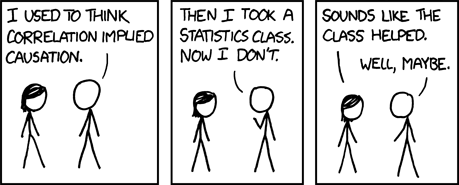
xkcd Comics

Causation vs. Correlation:
"Costco reported a profit of $537 million last quarter, up from $394 million during the same period last year, according to the Wall Street Journal. The healthy earnings report comes just six days after Jelinik urged lawmakers to raise the minimum wage to $10.10 an hour."

One year of profit reports as opposed to six days following a comment.


Straw Man Fallacy
"Costco makes more than $10,000 in profits per employee, while Walmart takes home about $7,400 per worker, according to the Daily Beast (Walmart and Costco aren’t exactly the same type of business, however)."

Costco (X) makes Profit (a). Walmart (Y) makes Profit (b)

You propose X:Y::a:b, but that is not remotely true.

If X /= Y therefore you cannot make assumption of a=b

source:

Read the Article at HuffingtonPost